

Hello and welcome to My Journey into Science Fiction Part 35. The Running Man, directed by Paul Michael Glaser has taken me to some unexpected and rewarding places during my research, and it is a film that I am glad I decided to explore a little more closely. The biggest revelation and most enjoyable moment was learning that the movie was loosely based on The Running Man novel, written by Stephen King under the pseudonym Richard Bachman. I had no idea that a remake of the film was in production, but after reading the novel, I did notice that the story takes place in 2025. The Running Man received mixed reviews from critics upon its release, and poor box office results showed that the general public felt the same way about the dystopian action film. However, as a twelve-year-old child, box office returns meant nothing to me, and the film was a favourite of mine for some time. Honestly, I had forgotten just how popular Arnold Schwarzenegger was in the eighties and early nineties, and his appeal was instrumental in my love for movies. It is also pretty outstanding how he brought science fiction to the masses and became one of us as his career continued. Anyway, The Running Man is slowly making its way back into popular culture, and as we move through the year, it will become a thought on everyone’s mind. I need to get this review finished. So I can sit back and watch it flow back into the zeitgeist, and I have to say, I’m pretty excited by it all.
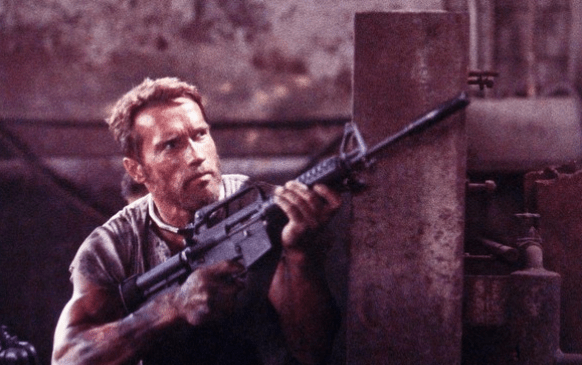
I don’t find it surprising that Arnold Schwarzenegger went on to make Total Recall with Paul Verhoeven. I would say The Running Man was heavily influenced by Robocop, a film released only months earlier in 1987, which received critical acclaim. Unfortunately, the distinction between a great director and one making his way out of television is clear for all to see. Behind every great science fiction movie is a solid script, satisfying special effects and an underlying message that can stand the test of time. Alternatively, there is the responsibility of bringing a film in on budget while still managing to stay true to the director’s vision of the film. I know it is easy to talk about such things, and the reality of a situation like this has many more aspects to the final cut of a movie. But I think The Running Man had the potential to become something far greater than the finished product, and it is those possibilities that let it down. However, the criticism that Glaser’s television background ruined the film is a little misplaced. Glaser replaced Andrew Davis as the director, who was fired after production fell behind schedule, and I feel the movie never recovered from that disruption.

The film takes place in 2017, in a future controlled by Government propaganda and censorship. The number one source of entertainment to keep the masses in control is the television show The Running Man. Prisoners of the state can win back their freedom by surviving in four quadrants of abandoned wastelands in downtown Los Angeles. However, they will also be hunted and executed if they are caught by the stalkers, Sub Zero, Buzzsaw, Dynamo and Fireball if that is their fate. Helicopter pilot Captain Ben Richards, Arnold Schwarzenegger believed he was on the right side of democracy until he was given orders to fire on unarmed civilians during a food riot. Richards refuses and is arrested and sent to prison for his offence. Ben has no desire to rot in chains for the rest of his life and escapes with two inmates, Harold Wiess, Marvin J.McIntrye and William Laughlin, Yaphet Kotto. Ben is asked to join the resistance and fight against a government that no longer cares for its citizens, but Richards shows no interest and has no faith in such a task, choosing to find his brother and enjoy his freedom. However, at his brother’s apartment, he finds Amber Mendez Maria Conchita Alonso living there instead. Amber, an employee of the broadcaster ICS, tells Richards that his brother has been taken away for re-education. Later, Amber has no choice but to help Richards get through airport security, but she alerts the authorities, and he is captured and taken away. He is the Butcher of Bakersfield, after all. During a news bulletin, Amber watches as Ben kills seven people during her ordeal, something that never happened in reality. Amber soon starts to doubt the government and their reluctance to tell the truth. Someone else watching the news coverage is Damon Killion, Richard Dawson, host and creator of The Running Man, and he only sees potential in Ben Richards, and he wants the Butcher of Bakersfield on his show, at any cost.

It was an impressive start to the film, and Killian using Weiss and Laughlin as a bargaining tool to get Richards on the show was suitable, but it suddenly makes the world of The Running Man feel small in scope. Unfortunately, the faults that start to appear in the film are there for all to see, and I am not sure if this was due to budget constraints or the lack of talent in the visual effects department. However, this is not what I want to discuss about the film because it is some of the flaws that make the movie unique to me. The iconography of The Running Man still stands out today. The suits used by the contestants look visually impressive. The stalkers may look a little outdated, but they offer a bit of showbiz to the proceedings, and the opening show with the dancers and a crowd screaming for blood makes you believe in this future landscape. Damon Killian is a worthwhile antagonist and always felt like a flamboyant Gene Pitney. However, I can now see how he represents a Government that no longer cares about its citizens. Damon shows no compassion for those around him and will use people as disposable tools, simply charming. The Running Man film still has something to offer me as a viewer, but after reading the novel, this review has turned into something I never expected.

I think Arnold Schwarzenegger’s performance is great in the film but I can now see that his character is a product of the eighties. He loves big guns, both figuratively and literally, and he seemed to have lived a decent lifestyle before his incarceration. He is the American dream. The looks, the charm and finally the woman cementing his place as the number one hero. As a child, that was all I needed, but as an adult, I want to take a look at how this world really works. In the movie, you get a few glimpses of dystopian desperation, but in the novel, you can taste it. However, when you bring the film and book together, your imagination creates something that is far more impressive and I can see why Edgar Wright would want to return this story to the big screen. I prefer the ending in the film to the one in the novel, but I love the grittiness of the book. I guess there is one way I am looking at this now, the book is Act One, the eighties film is Act Two and the third and final act will come in November.
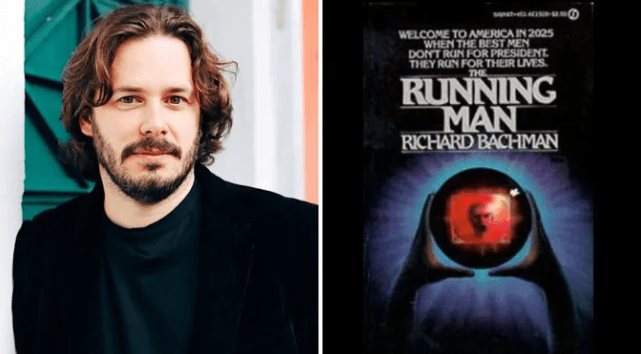
I guess, the only way to end this review is by saying it has only just begun. The Running Man was an ideal gateway into science fiction for me as a child. It had a lot of action, some famous one-liners and memorable scenes to share with your friends at school and the beauty of Maria Conchita Alonso was not lost on me and still isn’t. And still, it lets you know about the power of corruption, the importance of our freedom and how easily a society can tear itself apart. The novel, on the other hand, has everything I need as an adult who understands the complexities of society through experience. I’m not sure how the general public felt about Richard Bachman in 1982 when he released The Running Man. However, the anger and distrust in society by Stephen King’s alter ego comes across as normal in 2025. The novel also makes me wonder if we are on the knife’s edge of such an environment, or if we have already fallen on either side a long time ago. I have my views, but they are irrelevant to others and we can and should make that decision ourselves. Alternatively, it’s important to understand your place in society, think about those around you and act accordingly. The novel has a great way of pointing that out to you, just like a great science fiction story should. Now, all that’s left is the third part of a trilogy I didn’t expect to find. I say a trilogy because each story will be different, but they all will be a snapshot of a certain moment in time, and I think they belong together somehow. I am curious to see what Edgar Wright thinks The Running Man represents today. All I can say is, watch this movie, read the novel, then sit back and relax, because this will all start to gather momentum soon enough, and I think this story still has a lot to say.
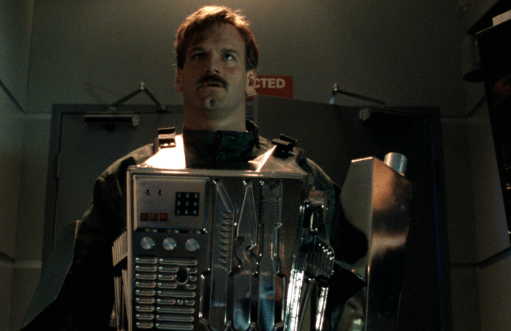
So, where will I go next in My Journey into Science Fiction Part 36? The funniest scene in The Running Man involves Jesse Ventura as Captain Freedom. Damon Killian orders the retired stalker to face Ben Richards, but he refuses unless it is a fair fight. However, his suit gets in the way as he tries to prove his point. It’s simply a funny and enjoyable scene that made me laugh during my recent re-watch. Jesse Ventura also makes an appearance in Demolition Man, 1993. A film I have watched before, but remember very little about. However, I look forward to watching the American science fiction film, directed by Marco Brambilla and stars Sylvester Stallone and Wesley Snipes.
Thank you for visiting today, it really is appreciated. If you enjoyed this review, please leave me a like or comment below. Also, if you would like to follow my journey on this site, please subscribe for future posts.
My Journey into Science Fiction Archives.
Inside My Projects.
Make a one-time donation
Make a monthly donation
Make a yearly donation
Choose an amount
Or enter a custom amount
Your contribution is appreciated.
Your contribution is appreciated.
Your contribution is appreciated.
DonateDonate monthlyDonate yearly Perhaps One Did Not Want To Be Loved So Much As To Be Understood.