
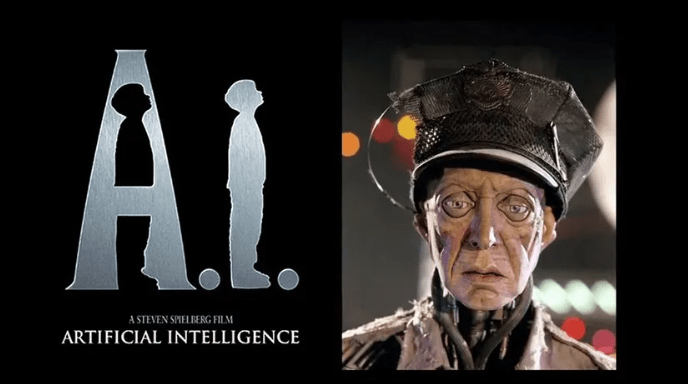
Have you heard of the film critic Mark Kermode? In England, he has always made his way onto the television and radio stations to share his view on the latest celluloid delights. I guess he could be described as a national treasure to some people. I have always enjoyed his wit from afar until I found one of his books in a local charity shop. However, something this important should belong in a museum. The book gave me a great insight into the career of one of Britain’s finest critics. It was also hugely entertaining and funny, well worth the couple of pounds I paid for it. I also learnt something new about the great film critic, which was quite a revelation. It turns out that Mark gave A.I. Artificial Intelligence a negative review upon its release. I very much enjoyed A.I. when I watched it at the cinema. Later, the film critic gave Steven Spielberg a public apology, declaring that the film is one of the director’s most enduring masterpieces. I was pretty curious about this change of heart. I hadn’t watched the movie in over twenty years, so why did I enjoy it in the first place, and would it still feel the same to me now?

I must admit it’s only over the last decade, that I have started to look more closely into the life and films of Stanley Kubrick. I was aware of him as a director and his involvement in A.I., but it’s only now that I can truly see his presence within the film. After all, Kubrick was the first person to acquire the rights to the short story Supertoys Last All Summer Long by Brian Aldiss in the early seventies. However, the director had meticulous attention to detail and left the project to gather dust as he realised the visual and special effects industry was not ready to achieve his vision for the film. Life moved on, but Kubrick and Spielberg still discussed the story regularly. It was only after the death of Stanley Kubrick in 1999 that Spielberg put the project into production, dedicating the film to his close friend.

Given my new insights, I must admit that the film feels completely different. I don’t know if that has anything to do with my newfound knowledge, the passing of time or the constant chatter of artificial intelligence in the real world. It could be all of the above, but I feel like I am now watching the film with more depth and an even greater appreciation for the movie. The story takes place in a futuristic post-climate change society. David Haley Joe Osment is the first artificially intelligent childlike android who is programmed with the ability to love. Androids are vast in this society, providing stimulation to humanity, but are mostly used as a tool of convenience. Monica Frances O’Conner and her husband Henry Swinton Sam Robards, are struck by tragedy as their biological son is placed in suspended animation after he is diagnosed with a rare disease. Unable to come to terms with her son’s illness, Monica’s husband hopes to ease his wife’s pain with the introduction of David, a Cyberdyne Systems Model 101.
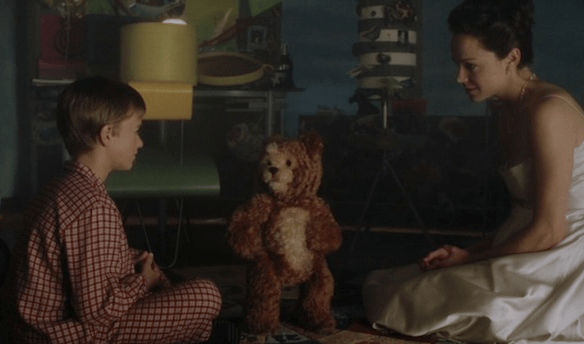
I enjoyed the film the first time around, for all the wrong reasons. I must have felt some compassion for David, but I think my brain was simply in popcorn mode. Let me explain. I think most of us are fans of Steven Spielberg’s blockbusters, and I still remember the tears streaming down my face after leaving the cinema after watching E.T. in 1982. In 2001 the technology Kubrick craved was now available and I was ready to get lost in its beauty. A.I. looked amazing and maybe that’s all I wanted. I went along with the fairy-tale symbolism of Pinocchio, fell deep into the world Spielberg created and finally came away with some optimism that we are not alone in the Universe. Okay, I might be laying it on a bit thick, but I was entertained, fully unaware of the dark tragedy that was blatantly obvious to my seemingly immature eyes.

I don’t think I was taking artificial intelligence very seriously as a twenty-five-year-old. However, I will not be too hard on myself because that was nearly half a lifetime ago. Maybe the tragedy within the film is obvious but I was ignorant, uneducated or simply unsympathetic to future challenges we may face. Maybe, I wasn’t taking it seriously, but Stanley Kubrick was already asking himself the hard questions in 1968. Fast forward to 2023, and my mind is now open to considering the real implications of the film. However, once you scratch the surface, those questions and answers cannot be expressed in a few paragraphs alone.

I should at least discuss some of the moments that did make a significant impact on me this time around. Humanity does not come across positively in this film. As humans, we always want to try and protect those around us and ourselves from harm. Nobody likes suffering, so how far would you go to avoid that? You feel for the Swintons, but Monica only wanted to receive love to relieve her pain. So when her biological son makes a full recovery, she no longer needs it from an android anymore. Professor Allen Hobby William Hurt created David in his deceased child’s image, simply trying to replace the loss in his life. All one-way traffic, and here they are, trying to add love to a machine, an emotion we will never learn to figure out ourselves. Love also brings out responses less desirable, such as jealousy which Giglio Joe Jude Law witnesses first-hand as one of his clients is murdered in cold blood by an enraged lover. Androids in this future, are also discarded once they are no longer of use, with most devices left to be hunted and destroyed at a flesh fair for our amusement.
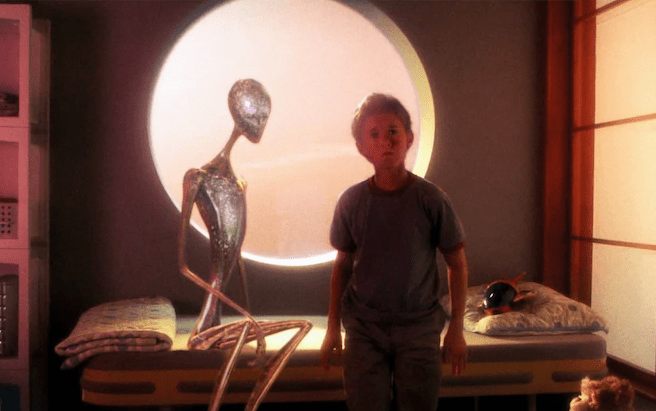
There is empathy. Unfortunately, it only comes from the androids themselves. I’m not sure if Giglio Joe and the androids that try to protect David show this emotion, or if they are reacting to the environment around them. A teddy bear android that belonged to Swinton’s son is the only person who shows compassion towards David. At every step of his journey, Teddy is right beside him. The Swintons are unaware that Teddy is anything more than a toy. Maybe this film is about Teddy because I’m guessing that empathy was not part of his program when he was created, which can only mean learned behaviour. I do like the ending of the movie, it’s joyful that Spielberg and Kubrick gave me something that made me all warm and fuzzy inside, knowing all’s right with the World again. Maybe the ending is there so I don’t need to think about the moment when a childlike android tried to commit suicide because he couldn’t get what he wanted and was unable to control his feelings any longer.
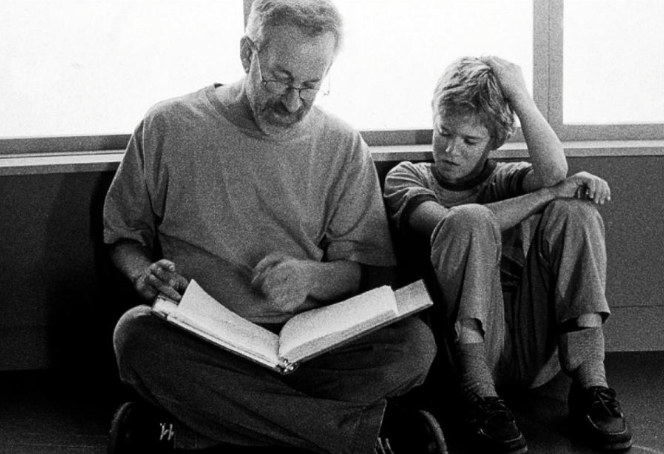
Well, I hope that cheered you up. A.I. is a dark film, and when you think about it, it’s a cautionary tale about the future. I hope the powers that be, watch it again for themselves before taking the next step, which does seem to be coming. It’s hard to work out who’s responsible for the true vision of the film. The idea began with Brian Aldiss, whose story I enjoyed, but it was a long way from the final product. Ian Watson, who was commissioned to write a screenplay for Kubrick, had a lot of influence on the final draft. Stanley Kubrick was not afraid to ask the audience questions we didn’t want to answer. And finally, Steven Spielberg managed to bring it all together seamlessly. History says this was not an easy film to make. People were angry, and feelings were hurt. Maybe that’s what makes us all unique, so many different opinions and ideas, all forming into something I would say, is an enduring masterpiece. The film seems so quiet now, from one that felt so loud. Modern Blockbusters have certainly helped with that. A.I. artificial intelligence is growing old gracefully and becoming a film that matters.
Thank you for visiting today, it really is appreciated. If you enjoyed this review, please leave me a like or comment below. Also, if you would like to follow my journey on this site, please subscribe for future posts.
My Projects.
Make a one-time donation
Make a monthly donation
Make a yearly donation
Choose an amount
Or enter a custom amount
Your contribution is appreciated.
Your contribution is appreciated.
Your contribution is appreciated.
DonateDonate monthlyDonate yearly
 Perhaps One Did Not Want To Be Loved So Much As To Be Understood.