

Hello, and welcome to My Journey into Science Fiction Part 27. Freejack is a science fiction, cyberpunk action film directed by Geoff Murphy. The screenplay was written by Steven Pressfield, Ronald Shusett and Dan Gilroy, and the story is loosely based on Robert Sheckley’s 1959 science-fiction novel, Immortality, Inc. The film, produced by Morgan Creek, and released by Warner Brothers, managed to make a 7-million-dollar profit at the Box office from a 30 million budget. Freejack received mainly negative reviews on release. Despite the criticism surrounding the film, I feel optimistic about watching it. Wish me luck, and see you on the other side.
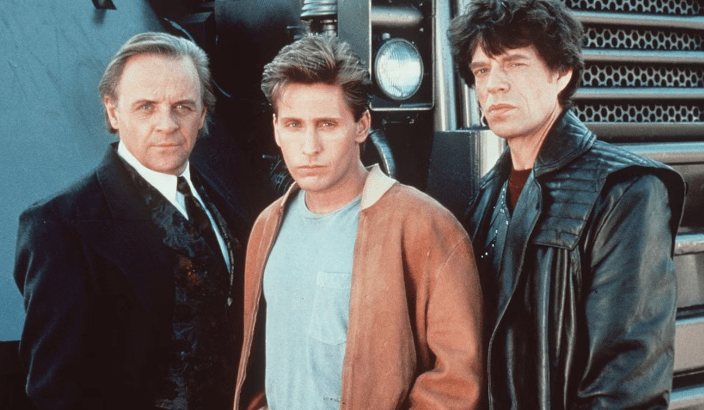
Well, that was certainly a thought-provoking film to watch. First of all, I would like to say that the opening credits looked very promising, and the music by Trevor Jones was feeding my brain with visions of something as cinematic as Blade Runner. However, it wasn’t long after the start that things started to feel slightly clunky. Instead of tears in the rain, you will get the splatter of feathers from the national bird of America and a nibbled ear. I’m not sure how much this film resembles Immortality, Inc., but I feel like the overall spine of the movie is supported by Robert Sheckley. I guess I will only find that out after reading the novel. I could be wrong, I could be right. I felt the originality of Sheckley’s idea is like the Atlas of the film, carrying all the extra ideas, gags and rewrites on his shoulders on bent knees.

The story of Alex Furlong Emilio Esteves is captivating and should be very effective in a science fiction film. Alex is a racing car driver, whose body is snatched by a time machine moments before his death on the racing circuit in 1991. At this point in the story, it’s all coming together nicely. Furlong is an up-and-coming star of the sport and he is obviously in love with Julie Redlund Rene Russo. I guess you can feel the weight of catastrophe and understand how this is a painful moment for all involved. Okay, maybe there are a few glimpses of pure schlock in the opening of this film, but that is nothing compared to what comes straight after. Before I moan about this film, it is worth pointing out that Geoff Murphy asked for his possessory credit to be removed from the film. Emilio Estevez also said he felt let down by Murphy because the director focused more on the action in his final cut of the movie. I will discuss this later, but I think this is where studios always fail.
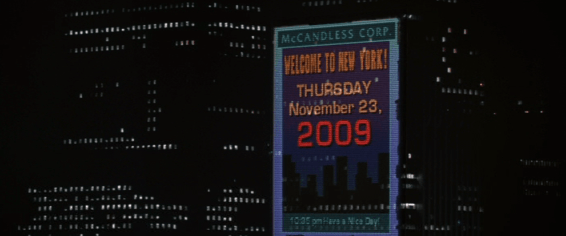
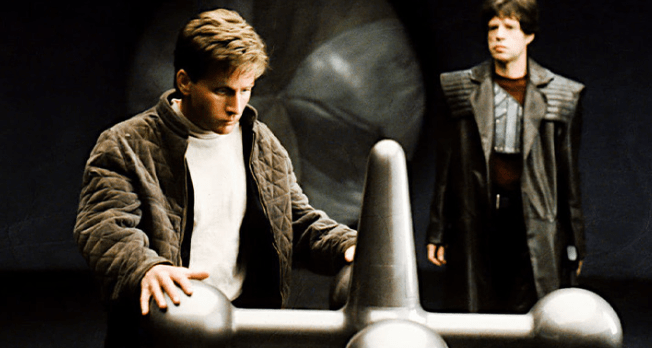
In this story, the super-wealthy of the future can achieve immortality, by the way of a mind transfer to another human being. However, in the future, the World’s resources have plummeted, pollution is slowly destroying the Planet, and most people live in poor physical health. However, Alex Furlong is in perfect physical health, and after a quick mind wipe, he is worth a lot to the right client. Victor Vacendak, Mick Jagger bonejacker and hardened mercenary is responsible for delivering this fresh piece of meat. Unfortunately, Victor and his crew are attacked by savages in this dystopian wasteland, and Alex Furlong escapes with his memories still intact. It sounds pretty decent, but when Alex arrives in the future, it radically begins to feel like Spaceballs or Flash Gordon. I mean, the whole scene as they try to wipe Alex’s mind is comical, and not in a funny way. Imagine booking a five-star hotel and learning that your view is terrible, or a favourite saying from around my way is, fur coat, no knickers.

The problem is that the story becomes way too complicated in its execution. Julie Redlund is an employee of the powerful McCandless Corporation. Alex, Julie and McCandless Anthony Hopkins become involved in a bizarre love triangle with few emotional beats. There is also another subplot with Victor Vacendak, who seems to have a strong dislike for his employees. I thought the ending inside the spiritual switchboard was beautiful, and those trippy computer-generated images took me back to the nineties. So, visually, the end was pretty sweet, but the story became tiresome. There were so many twists and turns that I lost all emotion for the characters and in the end, I was just bored. Alex pretends that McCandless’ mind swap with his host was a success, leaving him with the woman he loves. However, Victor sees right through Alex, even lying for him. However, I didn’t even care at that point. It was like fifteen films rolled into one, ranging from Laurel and Hardy to 1984. I think I was more concerned about why Victor never used his lie-detecting machine again in the film and, why does Alex become a beacon of hope? I am pretty sure all these answers ended up on the cutting room floor, in a state of desperation.
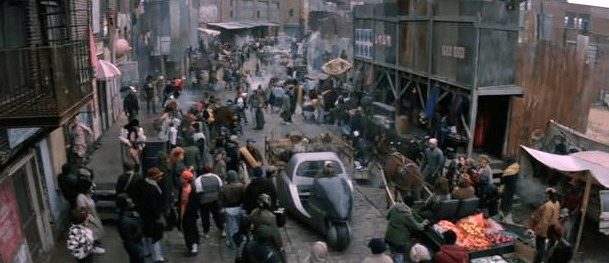
I learnt that Freejack went down like a lead balloon with a couple of test screenings, resulting in less than half of the movie being reshot. I guess that’s why I feel the story isn’t as powerful as it could be. That is pretty sad, as I thought the film had the chance to become something more valuable. Is it a thriller, action movie or comedy? Regardless of all my negativity, it is an enjoyable watch, but maybe for the wrong reasons. The production value of Freejack is commendable but very funny as well. I said earlier that the film reminded me of Blade Runner. Well, there is one shot that is identical to that film. However, instead of neon signs and beautiful imagery, you end up with wooden crates and chickens. The lighting is horrible, and it’s pretty colourless, and it just made me laugh.
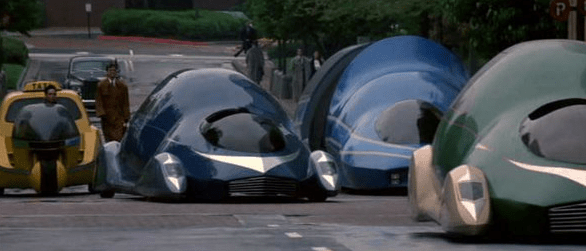
I do admire the film, and there is a lot to appreciate. I think the design of the cars in the movie are visually exciting and very reminiscent of the concept cars of the forties. Hip-swinging Mick Jagger and David Johansen gave a decent performance in the film, considering they are both from the music industry. Emilio Esteves was pretty bad, but if that look of confusion throughout the entire movie is acting, the man deserved an Oscar. Amanda Plummer is brilliant as the Nun and something I remembered almost immediately from my first viewing of the movie. Freejack is a bizarre viewing experience because some scenes look great, and then you have wacky races with absolutely terrible bluescreen backgrounds. My main issue with Freejack is that the studio didn’t know what the film was supposed to be, so neither did the audience. That is the real tragedy here because the concept is brilliant.
So, where to next on My Journey into Science Fiction Part 28? My first choice was Minority Report, 2002. Ronald Shusett was the Executive producer of the Steven Spielberg production. However, there can only be one winner, The Quiet Earth, 1985. Geoff Murphy directed this film, and it sounds pretty much perfect to me. Maybe a step in the right direction, I hope.
Thank you for visiting today, it really is appreciated. If you enjoyed this review, please leave me a like or comment below. Also, if you would like to follow my journey on this site, please subscribe for future posts.
My Journey into Science Fiction Archives.
My Projects.
Make a one-time donation
Make a monthly donation
Make a yearly donation
Choose an amount
Or enter a custom amount
Your contribution is appreciated.
Your contribution is appreciated.
Your contribution is appreciated.
DonateDonate monthlyDonate yearly Perhaps One Did Not Want To Be Loved So Much As To Be Understood.